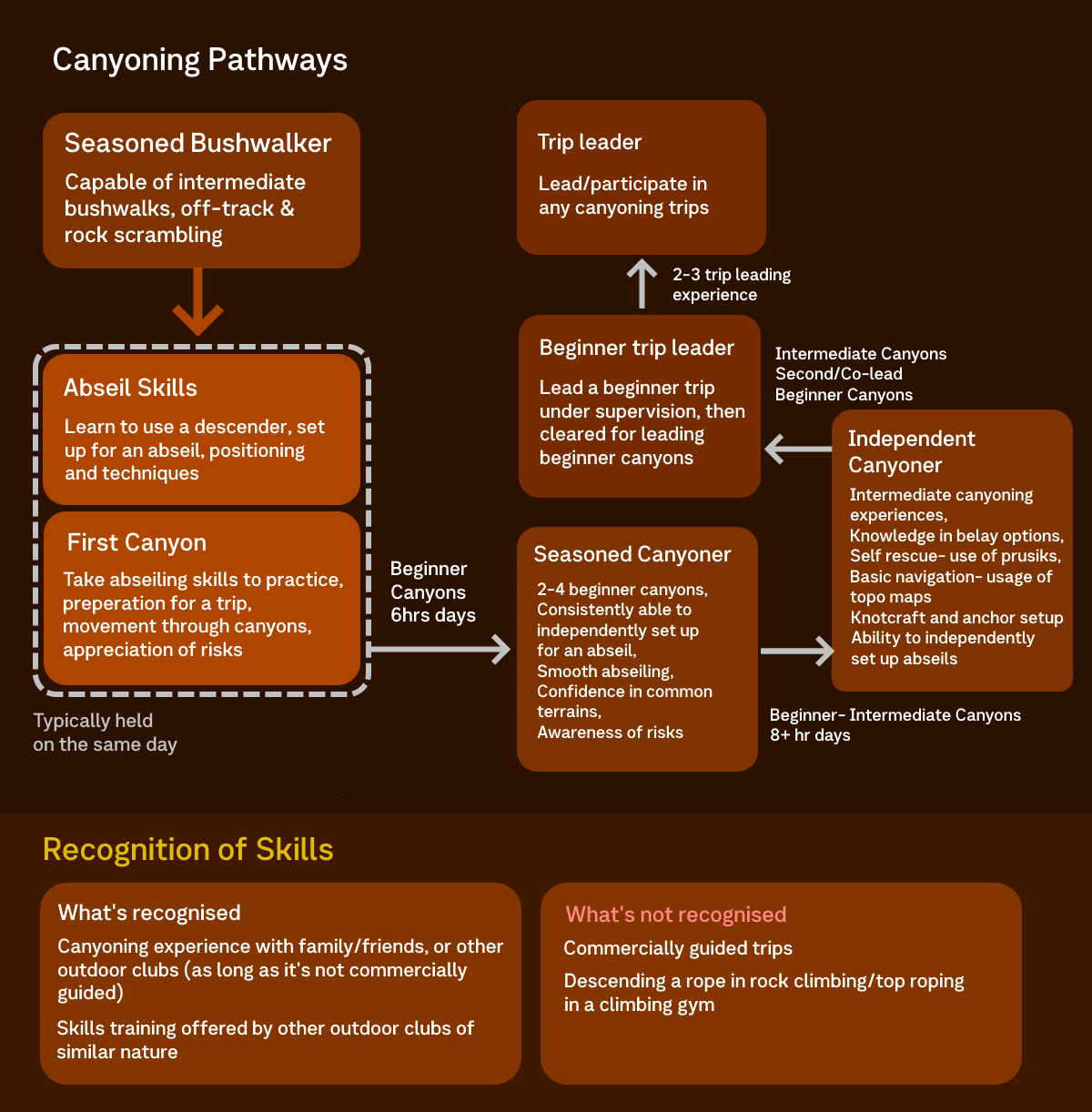
Trip leaders in SUBW run a wide range of trips of various experience levels. We do not have formal certification or endorsement of skills, and we’ll mostly gauge one’s experience through previous trips (doesn’t have to be with SUBW). Our trip leaders are usually very flexible and offer lots of leeway and opportunities for people to upskill or challenge themselves.
The charts below are there for your reference. If there’s a particular type of trip you want to go on, or if you want to build on a certain skill, that’s what you need to be keeping an eye out for.
Bushwalking is the bread and butter of our club. Lots of people get into bushwalking through our club, but we also welcome those who have experience with family or friends, or from overseas. If you’re looking to get into bush camping or overnight trips, look out for beginner camping trips posted regularly throughout the year. We have an annual Freshers Trip in March or April, offering beginners who are comfortable with full-day bushwalks a taste of camping. Lots of trip leaders will also accept beginners on easy camping trips, provided that they meet the prerequisite of intermediate, full-day bushwalks.
Another overnight trip that we run every year is the President’s Bludge Trip (PBT), held during the October long weekend. Distance-wise, it lies towards the beginner camping category, but it’s also more similar to an intermediate trip with off-track bushwalking and occasional rock scrambling. Christmas Dinner Walk, held every December, is a good beginner camping trip for those who are new.
All remote trips will require previous multi-day experiences. This is to ensure that everyone has the fitness and knowledge for the trip. You will be carrying loads of up to 15kg, 8 hours a day, over the entire trip. In Alpine walks such as in Tasmania, you’ll need to have your own insulating and shell layers.
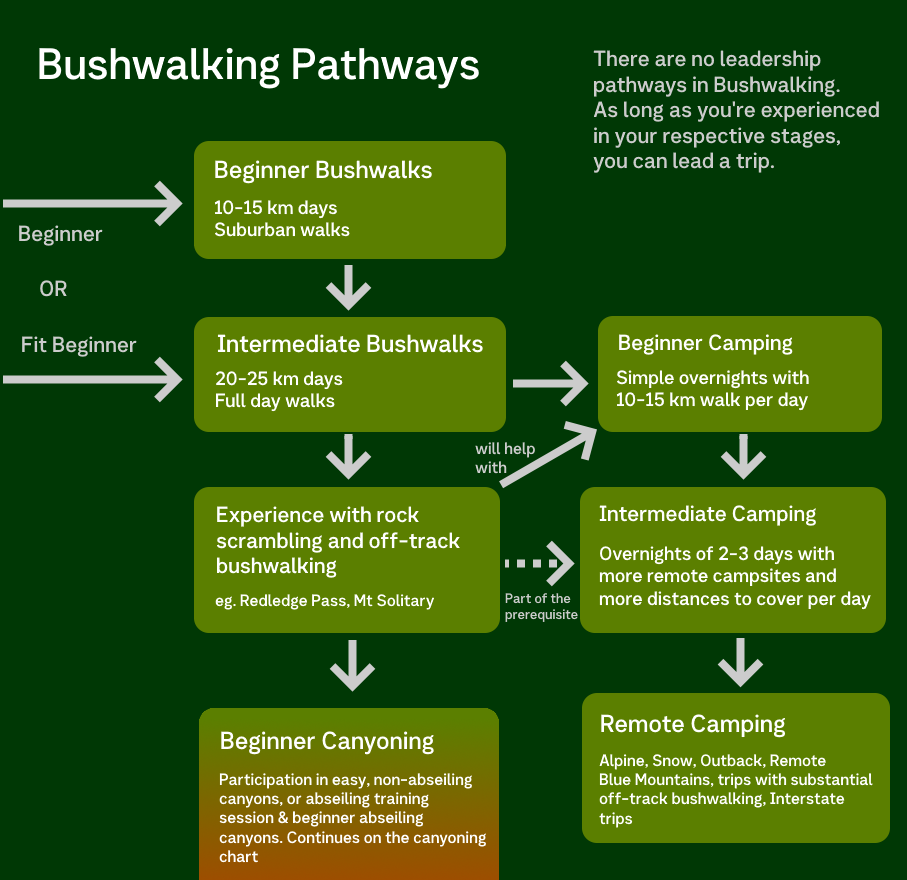
Canyoning is an exciting activity usually done during the warmer months (ie. October to April). There are also dry canyons and abseils, which are done during the winter months. It involves frequent, long sections of swims, rock scrambling, bushwalks, and even off-track bushwalking. Beginner canyoning trips are of a different level compared to beginner bushwalks, and require good fitness. Even physically fit people will find the mix of swimming, scrambling and abseiling in beginner canyons quite physically exhausting. The level of fitness required in a full-day bushwalk, plus being comfortable with rock scrambling, will set you up for a comfortable beginner canyoning day.
Occasionally, there are non-abseiling canyons that do not require abseiling skills. These trips are open to anyone with intermediate bushwalking experiences, and are a great way to get a taste of what canyons are like.
Abseiling training sessions are regularly held, and this is probably one of the few formal training sessions our club holds. It usually involves a pre-reading that you’ll complete at home, and on that day, you’ll be shown how to set up for an abseil, and you’ll have a few practice runs putting new knowledge into practice. Sometimes we’ll also do a short canyon (taking 2-3 hours) on the same day.
With a few canyoning trips, you will build on your confidence and skills with abseiling and scrambling in canyons. You’ll also make a few mistakes- they’re all part of the game. Usually, new canyoners will have the confidence and knowledge to abseil smoothly and independently after about 3-4 canyoning trips. At this stage, you’ll be welcomed to join our more intermediate trips, which are longer and more committing compared to the beginner ones. They are more physically demanding, but also a lot more fun!
To further upskill, you’ll be invited to another rope skills day. This time, we will teach you how to self-rescue so you can get out of trouble, and potentially how to set up abseils. We’ll also encourage you to start leading beginner trips or take up more leadership roles in canyoning trips. Having that knowledge is important as you go on more difficult canyons, and you’ll also be more likely to be accepted on canyoning trips if you have that skill.
Teamwork and communication are also very important in canyoning trips, if not more important than good knowledge and skill. Communicating effectively and actively taking up tasks helps us run trips safely, smoothly and efficiently. If your communication skills are patchy, you might have difficulty convincing trip leaders to take you on a trip.